
Artificial intelligence, virtual worlds, and personalized stories: What will movie night look like in the future? We take a look ahead to 2050 and ask ourselves what will change – and what will remain the same forever.
Movies at the touch of a button, virtual actors, and advertising that knows you better than some friends: There's a lot to suggest that our movie nights will change drastically in the next 25 years. But despite all the technology, one thing might remain surprisingly constant.
A perfectly normal Friday evening in 2050. You come home, flop onto the sofa, and hear a friendly voice from the living room: Your AI asks, "Would you prefer a thriller with 28-year-old Sandra Bullock, a sci-fi adventure with digital Humphrey Bogart, or the romantic comedy I created especially for you yesterday?" You opt for the thriller. "Good," the AI replies. "Should the main character win or fail? And can the dog survive?"
Sounds crazy? Perhaps. But if we're honest: If someone had told us in 2000 that we'd be streaming thousands of movies and series anytime on our smartphones, TVs, or tablets, we probably would have reacted with similar skepticism. So, what might our movie night look like in 2050? Here are some developments we consider quite likely.
AI Becomes Your Personal Program Director
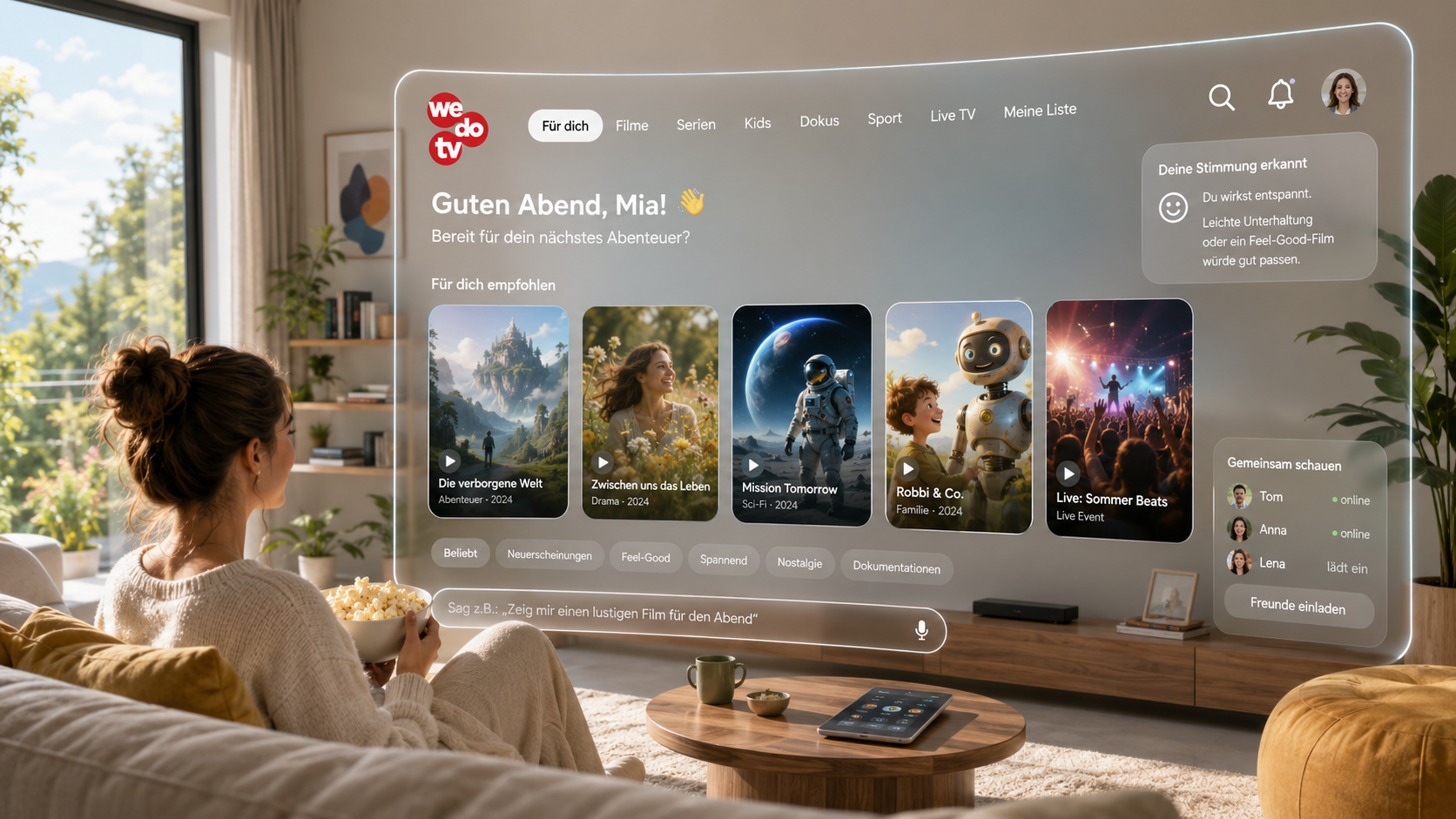
Today, many people spend more time choosing a film than actually watching it. The sheer volume of content can sometimes be overwhelming. By 2050, artificial intelligence is likely to significantly alleviate this problem. Instead of scrolling through endless menus, an AI could consider our preferences, habits, and even our current mood. It might know that we prefer to laugh on Friday evenings, enjoy documentaries on Sundays, and would rather not watch tragedies after a lost football match.
Instead of hundreds of suggestions, there might then be just one: "This is what you should watch today." Convenient? Absolutely. A little unsettling? Perhaps.
Everyone sees a different version of the same film
Developers and producers are already experimenting with personalized content. By 2050, this could evolve into something we've only known from science fiction until now. Imagine you're watching a crime thriller. Your neighbor watches the same film – yet experiences a different story. In your version, the culprit escapes. In theirs, they are caught. Perhaps the viewer themselves will even decide whether a story should be told in a more romantic, thrilling, or humorous way.
Purists will probably throw their hands up in horror at this idea. After all, art also thrives on everyone experiencing the same story. On the other hand: Who hasn't been annoyed by a film ending and thought: "That could have been handled better"?
Will AI soon produce entire films?
That is probably the most exciting question. Already today, AI systems can generate images, imitate voices, and create short videos. The quality is increasing rapidly. By 2050, it could be technically possible to generate complete films on demand. You input:
“An action-comedy set in Berlin. Two mismatched friends. 90 minutes. Humor like in the 2000s. Happy ending.”
A few seconds later, your personal film starts. But caution is advised here. Because just because something is technically possible doesn't automatically mean it will produce the best stories. The greatest films in history weren't successful because an algorithm calculated them. They were successful because creative people had surprising ideas, took risks, and evoked emotions.
Therefore, a different scenario seems more likely: AI will support filmmakers, but not completely replace them. At least not so quickly.
Actors could become immortal
Another topic is already causing discussions today. What happens when digital versions of actors become increasingly realistic? By 2050, famous performers might still appear in new productions decades after their careers end or even after their death. The technology for this is already developing. Fans could experience their favorite stars on screen again and again. At the same time, new questions arise:
Who actually owns a person's digital likeness?
Who decides on its use?
And where is the line drawn between homage and abuse?
The technology will likely arrive. The societal debate surrounding it, however, will probably continue for a long time.
Movie nights are becoming more social again
While streaming was primarily an individual experience for a long time, this trend could partially reverse in the future. Already today, people watch videos together, comment on content on social networks, or host virtual watch parties. By 2050, such experiences could become significantly more immersive. Perhaps your best friend is in Madrid, your sister in Stockholm, and your son in Sydney – but during the film, you'll still feel like you're sitting together on the same couch.
Virtual spaces, avatars, and new forms of communication could bring shared television viewing back into focus. Because despite all the technology, one insight remains remarkably constant: people love to share good stories with others.
The advertising of the future will know you very well.
Let's move on to a topic that many viewers probably view with mixed feelings, but which is wedotv's revenue model: advertising.
Even in 2050, it will likely not have disappeared. Free streaming services, in particular, will continue to rely on advertising for funding. The difference: advertising could become significantly more relevant. Instead of random ads, viewers might only see spots that truly match their interests. That sounds pleasant at first. The downside is obvious.
The better advertising is tailored to individuals, the more data will be required. Therefore, the question of data protection and privacy will likely become even more crucial in the coming decades than it is today. The challenge will be to strike a reasonable balance between convenience and data protection.
What probably won't change
Amidst all these technological developments, it's worth looking at what remains surprisingly constant: people love stories. They want to laugh, get excited, be scared, cry, or discuss the ending. Whether these stories are consumed via a television, AR glasses, a holographic display, or an AI-generated platform is ultimately secondary.
Technology changes, but human curiosity does not.
Takeaway: The future will be different – but not entirely unfamiliar.
No one can say for sure today exactly what a movie night in 2050 will look like. It's likely that artificial intelligence, personalized content, and new forms of shared viewing will change our media consumption more profoundly than we can imagine today. At the same time, there's much to suggest that streaming won't disappear but will continue to evolve. Perhaps we won't choose movies anymore. Perhaps they will be created for us. Perhaps we'll watch them simultaneously with friends on different continents. Perhaps we'll even experience different versions of the same story.
But one thing is likely to remain true even in 2050:
A good story remains a good story. And that's precisely why people will continue to sit enthusiastically in front of screens in the future – no matter what they look like then.